
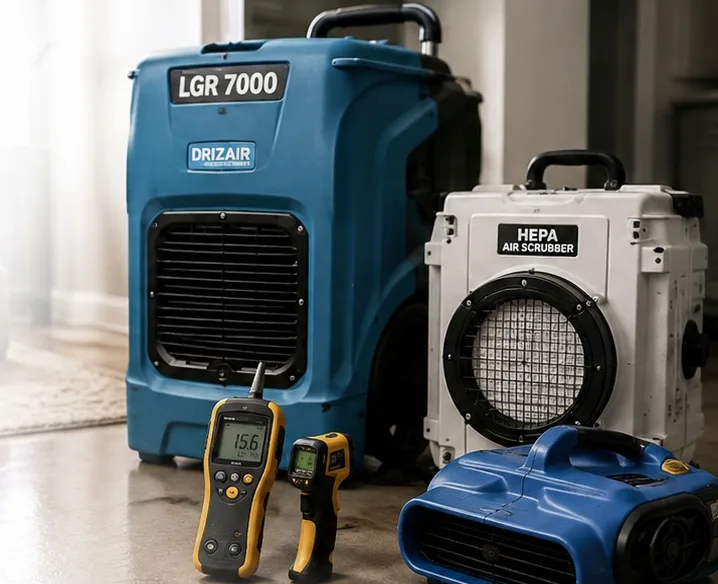
Real results.Tools that make a difference.
Equipment glossary
Professional equipment for better restoration.
Explore the equipment our crews bring to water, fire and mold jobs, and how each tool helps us dry faster, work safer and leave results that last.
- Commercial-grade
equipment - Faster drying
times - A cleaner,
healthier home
Our equipment
Restoration equipment we use
Each piece of equipment has a specific job in the restoration process. Here's what our crews use and what it does for your property.
-
Dehumidifiers
Pull moisture out of the air and out of wet materials, so structures dry in days instead of weeks and mold doesn't get a start.
Learn More -

Air Movers
High-velocity fans that push dry air across wet floors and walls, speeding up evaporation from carpet, drywall and wood.
Learn More -
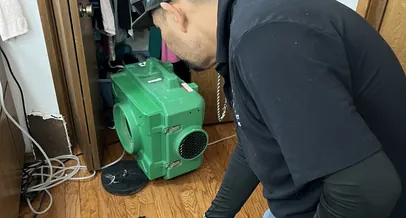
HEPA Air Scrubbers
Filter airborne dust, mold spores, soot and odors out of the room while work is under way.
Learn More -
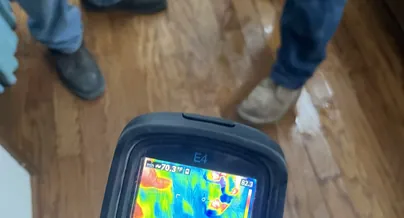
Thermal Imaging Cameras
Show temperature differences behind walls and ceilings that point to hidden moisture, before anything gets opened up.
Learn More -

Moisture Meters
Measure moisture inside drywall, wood and concrete, so we know where water went and can prove when it's dry.
Learn More -
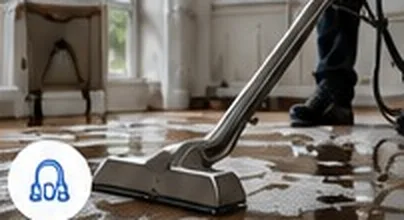
Extraction Equipment
Truck-mounted and portable extractors that remove standing water from floors, carpet and pad fast.
Learn More -

Negative Air Machines
Create controlled airflow out of a work area, so dust, mold and contaminants don't spread to clean rooms.
Learn More -

Specialty Drying Equipment
Ducting, injection systems and heat drying for crawl spaces, wall cavities, hardwood floors and other tight spots.
Learn More
No equipment in this category yet.

The difference
Advanced equipment. Better outcomes.
The right equipment changes how fast a property dries, how clean the air stays and whether problems come back months later.
Call (800) 719-4808- Faster recoveryShorter drying times and less secondary damage.
- Better air qualityMoisture, dust and contaminants filtered out while we work.
- Long-term protectionProper drying prevents mold and repeat problems.
Frequently asked questions
Equipment FAQs
Why is professional equipment important?
Household fans and shop vacs move air, but they can't pull water out of wood, drywall and concrete at a rate you can measure. Commercial dehumidifiers and air movers dry a structure to a set standard in days, and moisture meters prove when it's done.
How do you detect hidden moisture?
We start with thermal imaging to spot cool areas behind walls and ceilings, then confirm with pin and pinless moisture meters. Readings get logged so you and your adjuster can see exactly where the water went.
How do dehumidifiers work?
Low-grain refrigerant (LGR) units pull humid air across cold coils, condense the water and pump it out. Desiccant units use a moisture-absorbing wheel instead and work better in cold spaces or when materials need to get very dry.
What equipment do you use for large water damage jobs?
Truck-mounted extraction for standing water, then several LGR or desiccant dehumidifiers and air movers sized to the space. We set the equipment count from the room size and how wet the materials are, and adjust it as the readings come down.
Do you use HEPA air scrubbers?
Yes, on mold, sewage, fire and soot jobs, and any time demolition creates dust. HEPA filters capture at least 99.97% of particles 0.3 microns in size, which keeps the air cleaner while we work.
Do you use different equipment for mold remediation?
Yes. Mold work adds plastic containment, negative air machines to keep spores inside the work area, HEPA vacuums and air scrubbers, and protective gear for the crew.